


A reflection on a UK industry panel, the ARMSA Academy decision context model, and what becomes harder to see when developers are working under macro pressure.
What this piece argues, in three sentences
UK connections reform is a macro factor squeezing the space in which renewable project developers can make good early-stage decisions.
The senior developers on a recent industry panel were articulate about the financial and capacity consequences, but the conversation didn’t quite reach the construction and operational safety consequences travelling alongside them.
The ARMSA Academy Decision Context Model is a useful lens here, not because it explains that omission, but because it makes visible how macro factors set the constraints within which projects operate, and why developers need to trace the downstream lifecycle implications of decisions made under those constraints.
I sat in on a UK industry panel on connections reform recently. Four senior developers in front of an audience of their peers, an experienced moderator, an hour of remarkably honest discussion. One of the panellists framed the developer mood as the stages of grief: shock, denial, anger. He got laughter that was a little too quick, a little too knowing.
It was the kind of session where the value isn’t in any single contribution. It’s in the cumulative weight of what concerns are surfaced, and which ones aren’t. I’ve been turning it over since.
What is connections reform, briefly
For readers coming in cold: connections reform is the most significant overhaul of how renewable energy projects connect to the UK electricity grid in decades. It is led by the National Energy System Operator (NESO), with regulatory approval from Ofgem and policy backing from the UK Government’s Clean Power 2030 Action Plan.
The old “first come, first served” model produced a connection queue of around 750GW by early 2025, roughly four times what Great Britain actually needs to meet its 2030 clean power target. Speculative or stalled projects held queue positions ahead of viable, ready-to-build ones. Investment was blocked.
The new “first ready and needed, first connected” model (the reform package is technically called TMO4+) prioritises projects on two criteria. Readiness means demonstrable land rights and planning progress. Strategic alignment means the project fits the technology mix the country needs under the CP2030 Action Plan.
Projects pass through Gate 1 (indicative offer) and Gate 2 (firm offer if readiness and alignment are evidenced). Within Gate 2, projects are then split between Phase 1 (those scheduled to connect by 2030, supporting the Clean Power 2030 target) and Phase 2 (those scheduled to connect between 2031 and 2035, supporting longer-term system needs).
In December 2025, NESO published the new delivery pipeline: 283GW of projects prioritised for connection, of which 132GW are aligned with delivering Clean Power 2030. The reform is intended to unlock around £40 billion of clean energy investment a year. The principle is widely supported across the industry, including by every panellist I heard. The transition itself, as the rest of this article reflects, is where the friction lives.
Readers wanting to go further can consult NESO’s Connections Reform programme page for the customer handbook and full design documentation.
What the panel was wrestling with
The developer pain is real and well-defined. Connection offers are arriving with appendices missing. Gate 2 connection agreements that should anchor procurement are still not in hand for projects with scheduled 2026 and 2027 delivery dates. Bidding into the next CfD round means signing turbine contracts without certainty about when, or whether, the connection will actually arrive, thereby pricing in risk that wouldn’t otherwise be there.
Multi-technology projects (a single development combining, for example, solar with battery storage) are now being assessed stage by stage under the new framework, with each technology evaluated separately against the readiness and strategic alignment criteria. The result has been that solar and battery stages of the same development can end up with different outcomes (one stage Gate 2, the other Gate 1), described from the floor as the unwinding of “the dream ticket” of co-located generation and storage, with no clear path to bringing the stages back together commercially.
The panellists were measured and constructive. They repeatedly acknowledged that the principles of connection reform are correct. They want it to work. They were articulating the cost of the transition from a system that everyone agreed was broken to one that hasn’t yet stabilised.
What struck me, and what I want to reflect on here, is what the conversation didn’t quite reach. Not as a criticism of the panel. As an observation about what becomes harder to see when an entire industry is operating under this kind of pressure.
How early-stage decisions shape lifecycle outcomes
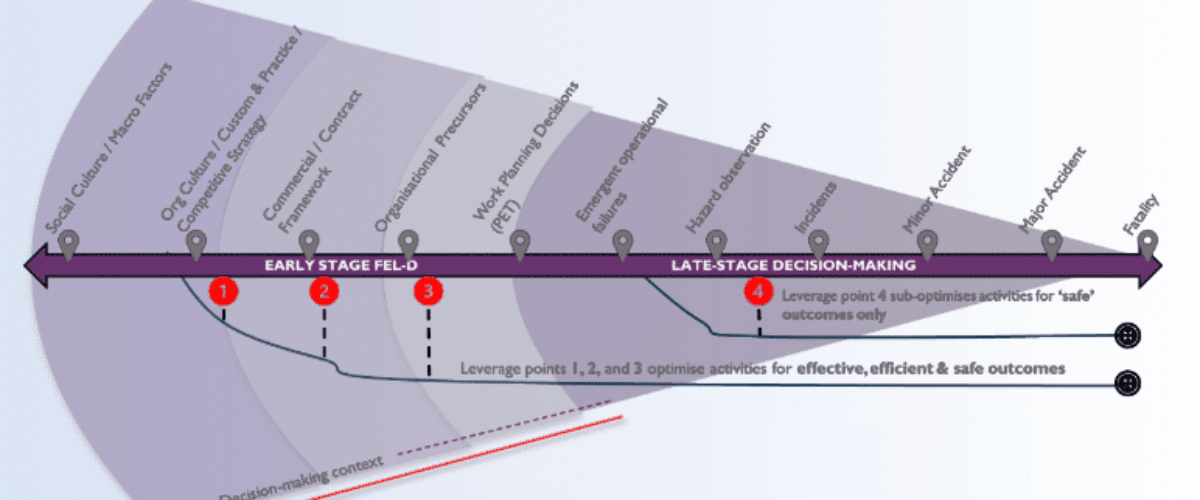
ARMSA Academy’s Decision Context Model is a framework for thinking about how early-stage decisions in renewable energy projects connect to outcomes across the lifecycle. It looks like this:

The narrow end of the model is where incidents happen: hazard observations, near misses, minor accidents, major accidents, and in the worst case, fatalities. The wide end is where the decisions that shape those outcomes are actually made: organisational culture (Leverage Point 1 – LP1), commercial and contract framework (LP2), organisational processes (LP3).
At these earlier leverage points, decisions can still optimise for effective, efficient and safe outcomes together. By LP4, late-stage work planning, that capacity has narrowed: efficiency and effectiveness are largely already locked in by what came before, and safety is the dimension still open to influence. After LP4, that capacity diminishes too. The narrow end is what arrives once the leverage has been spent.
When developers are pricing CfD bids against uncertain connection delivery terms, that pressure hits Leverage Point 2 (commercial and contract framework). When stages of the same project land in different Phases of the new pipeline, with Phase 1 offers issued ahead of Phase 2 offers, developers can be required to accept the earlier offer before knowing the outcome of the later one. That hits LP3 (organisational processes).
When projects are optimised and re-optimised against shifting connection scenarios, the discipline of capturing the rationale behind each iteration, and surfacing its construction and operational consequences, becomes harder to maintain. Not because anyone is being careless. Because the early-stage decision space is being compressed by something outside it.
What gets harder to see in early-stage decisions
Across nearly an hour of frank, expert discussion, the conversation didn’t reach construction safety or operational safety. Cost did. Capacity did. Supply chain, attrition, financing, planning interaction with grid all did. Safety, as a category of consequence, didn’t surface.
I want to be careful here, because this is the empathetic point, not the accusatory one. The panel was asked about connections reform, and they answered. They are senior people doing their best inside a system that is pulling their attention in twelve directions at once. The squeeze is real. When the macro context is compressing your decision space hard, the things you’re under-attending to are not signs of poor practice; they’re signs of being human in a difficult environment.
What the model does surface is the inheritance mechanism. LP4, the late-stage point where the capacity to shape outcomes has narrowed, inherits whatever was decided earlier. A turbine contract signed under pricing pressure, with constructability assumptions baked in, is an LP2 decision with downstream physical consequences.
A Phase 1 connection agreement signed before the Phase 2 outcome is known shapes the LP3 process that everyone downstream will inherit. Layout iterations driven by changing connection date assumptions land on the same construction crews, the same O&M teams, the same access tracks, the same crane envelopes that ARMSA Academy’s 2024 cross-functional study on early-stage decision-making identified as the weakest links in the development-to-delivery chain. The macro pressure does not change that inheritance. It only makes the early decisions harder to take, and harder to capture in a way that the late-stage teams can use.
Ofgem itself, in its December 2025 reform package, acknowledged that connection delays have caused some developers to face costs “inflated up to 200%”. That figure captures the financial consequence but says nothing about the constructability consequence travelling alongside it.
This is the same pattern visible in our recent LVIA developer study, where landscape-driven design decisions reshape projects but rarely surface as logged design events with construction and operational consequences. The mechanism is different. The shape of the gap is the same.
Opportunities for development teams
ARMSA’s model offers an opportunity to minimise unknown unknowns which surface much later on in the project lifecycle. If macro pressure is compressing decision space at LP1-3, the response isn’t to ask developers to do more under that pressure. It’s to make the decisions that are being made, under whatever pressure, more legible to the people who will inherit them.
In the absence of everything else, three practical moves to start with are :
1. Capture connection-driven design decisions explicitly. Each design iteration triggered by changing connection assumptions is a logged design decision in waiting. The note doesn’t have to be long. “Layout revised on this date because of this assumption about connection timing” is enough to give a future construction lead a fighting chance of understanding why the project looks the way it does.
2. Bring late-stage voices into the early-stage room. The questions construction and O&M leads ask under normal circumstances are the questions worth asking under abnormal ones. Connection-reform pressure is exactly when you most want construction’s view on whether the rerouted track actually works for HGV deliveries, or O&M’s view on whether the revised layout protects access for maintenance.
3. Treat the develop-and-sell handover as a design-rationale handover, not just a contractual one. Where projects move between organisations under connection-reform pressure, the buyer needs the why alongside the what. The macro context that produced the decisions doesn’t travel with the planning consent. It needs to be deliberately captured.
The harder problem: unknown unknowns at organisational scale
The three moves above describe what a disciplined team can do. They do not describe what a real organisation finds easy.
In practice, renewable developers are large and distributed. Decisions are made across multiple teams, multiple time zones, multiple project stages, and multiple IT systems that rarely talk to each other. Documentation conventions vary. Capture discipline is uneven. People who know the project history move on. The connection-reform pressure compounds all of this: people are working harder, faster, and across more interfaces than the systems were designed for.
That makes the easy version of “log your decisions” much less easy than it sounds, and it leaves the harder problem unaddressed: how does an organisation surface the things its people don’t yet know they should be worried about?
You can’t log an unknown unknown. But you can detect the patterns of inquiry that surround one. When the same question is asked across multiple teams, when confidence in an assumption keeps eroding in different conversations, when searches for similar information recur over weeks, that’s a signal. In most organisations today, that signal is invisible. It lives in individual heads, individual emails, individual file shares.
This is where digital tooling does work that team discipline alone cannot. ARMSA Academy’s h’alt® is a machine-learning-based decision-support tool built specifically for this gap.
As people search, verify, and consult through their work, h’alt® captures patterns of inquiry and surfaces them as organisational signal: where confidence is shifting, which questions are recurring, which project risks are emerging in the cognitive footprint of the team before they emerge as documented issues. It does not replace logging discipline. It catches what logging discipline cannot.
For a sector under macro pressure, that visibility is the difference between a hope that the right things get logged and a system in which the right conversations get prompted. The connections-reform squeeze does not lift. The question is whether organisations can see clearly inside it.
Why this is worth saying
The Decision Context Model is not a finger-wagging frame. It’s a reminder that decisions made early in renewable energy projects shape what is possible later, and that the wider environment shapes what gets attended to early. The panel’s discussion was an honest snapshot of how that wider environment currently feels from inside the development teams trying to navigate it.
Connections reform was the right reform. The transition is the painful part. And the role of someone outside the immediate decision space (researchers, observers, sector bodies) is to keep visible the parts of the picture that the squeeze is making harder to see.
If the questions raised here are useful ones to test against your own portfolio, the ARMSA Academy Renewable Project Development Readiness Benchmark is a short, free, anonymous diagnostic that maps early decision quality, construction and O&M readiness, and project governance across phase handovers.
Different organisations need different tools. For developer teams looking to build the early-stage decision discipline this piece describes, the ARMSA Academy IOSH Strategic Safety for Renewable Project Developers programme is built directly on the same research base.
For organisations looking to address the harder problem of capturing decision patterns across distributed teams, h’alt® is the digital decision-support platform built for that scale.
Sources and method: This piece reflects on a recent UK industry panel on connections reform. No participants are named. The Ofgem figure is from the Ofgem press release accompanying the December 2025 connections reform package. The ARMSA Academy Decision Context Model is the framework used to map early-stage decision-making and lifecycle outcomes in renewable energy projects, drawing on the 2024 cross-functional study of 33 development, construction and O&M professionals, and the 2026 qualitative study of eight developers and specialists on Landscape and Visual Impact Assessments.