
We asked around 1,500 people in the renewables industry where their business sits on an 8-pillar maturity model. Nobody selected the 8th.
The method was designed for a different kind of project
Search for approaches to managing construction risk and the results are consistent and, on their own terms, correct. Identify the risk. Evaluate it. Rate it by likely impact on the project. Control it. The technique has been settled for decades, and where it works, it works well.
It works well under specific conditions. High levels of experience. Proven technology. Mature supply chains. Clients and construction managers who have run this kind of project many times before. Take those four conditions away and the method starts to describe a project that does not exist.
Offshore wind is a young sector building at speed. The technology is still moving. There is a recognised shortage of skilled people. Supply chains are distributed across many countries and expanding faster than they can be assured. Labour migration is commonplace. RenewableUK reports 11.4 gigawatts under construction in the UK alone, following a record 8.4 gigawatt Allocation Round 7. That is a great deal of construction being delivered by an industry that has not yet had time to become experienced.
What 1,500 people told us
We surveyed around 1,500 people working in the renewables industry and asked what approach their business takes to construction health and safety risk management. The answers map onto an 8-pillar model of maturity, running from personal protective equipment at one end to full organisation-project alignment at the other.
The majority identified pillars 5 and 6. Very few selected pillar 7. Nobody identified the 8th pillar.

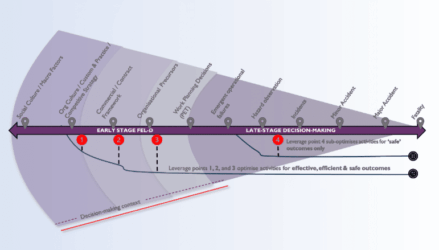
The pattern is worth sitting with, because the pillars are not a scale of effort. They are a scale of where control lives. The first half of the 20th century put control on the individual, through personal protective equipment. From the mid 1950s it moved to training, crew leadership, supervision and inspection. From the late 1980s it moved again, to construction safety plans and safety in design. The direction of travel across a century has been steady and in one direction: away from controlling people, towards controlling systems.
The 8th pillar is the next step in that line. It is organisation-project alignment, sometimes called the intelligent client: the client and the contractor devising a common and consistent way of delivering a project, then adjusting their roles, responsibilities and management systems to serve one project objective rather than several competing ones.
Join us live
Where control actually gets decided
The uncomfortable part is how little of this is decided on site.
Saving time on planning during the pre-construction phase is common, usually as a consequence of poor early decisions or under-resourcing. Every hazard that is not eliminated before construction begins increases the dependency on procedural safety measures once it does. Compromises on design reviews, hazard and operability studies and contractor engagement should not be tolerated, because each one converts a design problem into a site problem, and site problems are managed by people under time pressure.
Commercial health belongs in the same conversation. If project participants cannot guarantee delivery of components, or cannot pay their subcontractors, then construction controls can be written off entirely. Under that kind of pressure, even a project with genuine safety commitment will crumble and start cutting corners simply to reach completion. Macro level risk analysis during the development phase is not a governance formality. It is what stops a project arriving on site already compromised.
What to do with this
If you are a manager looking to embed effective construction risk management on a wind project, you should already be operating at the 6th and 7th pillar, and aiming for the 8th. Health and safety risk management in construction continues to evolve, and the approaches available freely on the web may fall short of what the wind power construction context demands.
Join the session with a real problem
On Thursday 3rd September at 11:00 BST, Khalida Suleymanova takes this argument through in a short session and stays in the chat throughout to answer questions against real projects.
It runs for 11 minutes, and there is Q&A throughout.