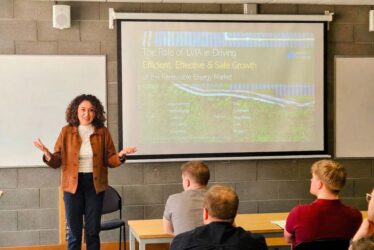
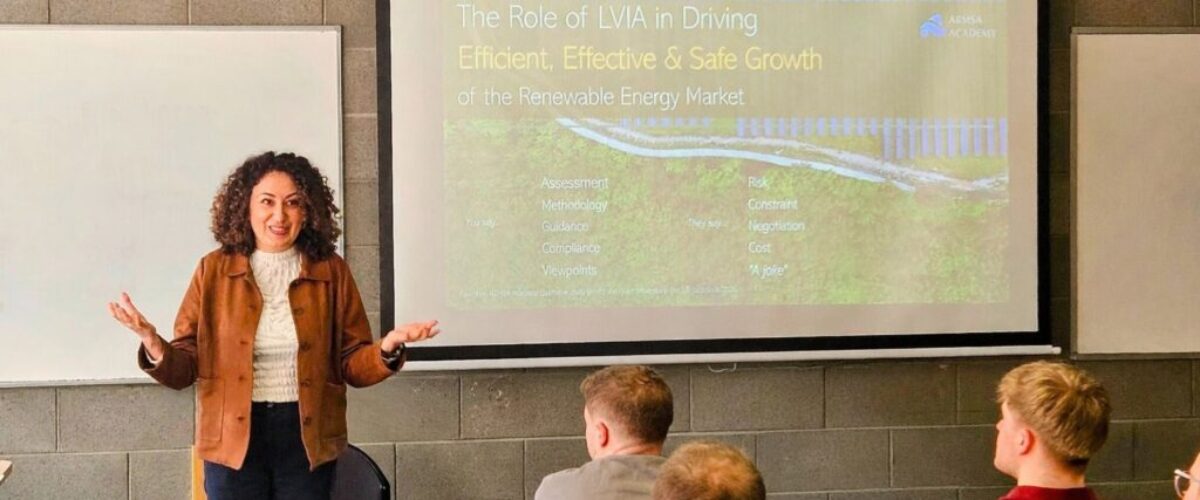



In March 2026, ARMSA Academy interviewed eight people who work with Landscape and Visual Impact Assessments, seven renewable project developers and a specialist visualisation consultant, across Ireland, Scotland, Wales, the wider UK, and Italy.
The aim was to build a clearer picture of how LVIAs actually function inside renewable projects and where their value really sits for the people who commission and use them. The participants were generous with their experience, candid about their own practice, and the resulting study is fundamentally a collaborative one. The findings below are theirs as much as ours.
The first finding is straightforward and uncontroversial.
Every developer described LVIAs as actively reshaping projects, turbine numbers, tip heights, layout, access track routing, and earthworks profiles. Solar developers described modules removed from layouts because of visibility from cultural sites.
Wind developers described turbine counts reduced across multiple design iterations, and access tracks were rerouted to satisfy landscape capacity. In the Italian context, mandatory perimeter tree-planting added significant CapEx and a long tail of operational obligations such as irrigation, vegetation management, and access constraints around mature planting.
LVIAs not only reshape projects, but they also help triage development efficiency. That much is uncontroversial.
The second finding is where the more interesting question sits.
Across the interviews, LVIA outputs were consistently described as planning artefacts, civil engineering inputs, and programme considerations, but rarely as design decisions to be logged.
The discipline of capturing the assumptions, design choices, and the rationale behind LVIA-driven design changes, as a project, is not yet how the LVIA process is framed in current developer practice. Any Principal Designer involved early in project concept stage will welcome a catalogue of these decisions.
The connection between those decisions and construction safety, operations and maintenance planning and access, and the long-term resilience of the project is not yet part of how the LVIA process is understood by the sector.
That gap, between the real value that LVIAs can provide to projects and how they are framed by the people commissioning them, is the subject of this piece.
But developers don’t see it this way
Understandably, developer’s reaction to this assertion is often:
At the LVIA stage, there isn’t even a project yet. We haven’t appointed a Principal Designer. The design isn’t really a design. Why would we treat it that way?
It’s a reasonable position. It’s also one that HSE countered directly in August 2025.
Why is a different perspective required now?
In a letter to the wind industry dated 22 August 2025, HSE’s Principal Inspector for Wind and Marine Energy stated that under CDM 2015 Regulation 5, where a client has not yet appointed a Principal Designer, the client “must undertake these CDM roles from the inception of the project.”
Whilst, “inception” is subjective, the HSE foresaw this confusion and provided an explicit requirement in relation to submitting an F10 notification. According to the letter, Clients (Developers) should submit an F10 notification to the HSE “at the commencement of a project to build a wind farm, regardless of whether concept drawings have been produced, or layout, grid connection, infrastructure, etc. has been decided.”
The phrasing is unusually direct for the HSE. But, the message is unambiguous: the duties don’t wait for the project to feel like a project.
This sets the scene.
So, what is the relationship between LVIAs and safety?
Both activities are front-end critical. LVIAs illustrate the choices made at the front end of a renewable project – even one in concept phase. Equipment choices, location choices, aesthetic choices, deforestation choices, construction choices, foundation choices… and the list goes on. Safety risks emerge from them.
Ignoring front-end risks
A separate ARMSA Academy survey of 33 development, construction and O&M professionals (2024) showed what happens when design decisions and their consequential risks aren’t inventoried and mitigated pre-FID.
80% of development respondents were neutral on whether their Design Risk Assessment process adequately captured hazards arising from technology choices. This reconfirms the status quo.
83.3% of O&M respondents linked incomplete safety files (containing details of residual hazards migrating from previous phases) at handover to actual safety incidents, for example, recent incidents involving asbestos-containing break pads.
c.66% of all project execution respondents linked missing residual hazard information to incidents and to increased maintenance costs.
The thread running through both studies is the same: when early decisions aren’t captured with discipline, the cost shows up later. And the cost is not always small.
The developer study surfaced a further wrinkle. Where the commercial model is develop-and-sell rather than develop-build-operate, the discipline is structurally weaker still. A highly experienced developer across multiple portfolio types, put it directly:
“if the construction and operation team is not in-house, in the same company, that process is not going to be done correctly.”
The information that isn’t captured at consent is the information that gets sold without it. Will more commercially astute due diligence processes pick this up in future?
None of this is unique to LVIAs; the same principle applies across every early-stage study that shapes project design (EIA chapters, ecology, archaeology, geotechnical, hydrology, noise), and because these studies take the form of fragmented workstreams, the discipline of logging early decisions and their rationale matters more, not less.
The opportunity isn’t a procedural overhaul
It’s a framing shift, made early enough to matter.
When the LVIA process produces a turbine reposition, an access track reroute, a tip height change, or a forestry clearance requirement, capture it as a design decision. Note the rationale. Hold it where your eventual design risk register will sit.
If the construction and O&M interface leads aren’t in the room when these decisions are being made, find a way to bring them in early; the questions they ask are the ones you (and lenders) want asked – and resolved.
If you’ll divest before construction, document the design rationale anyway and include it with the consent, not separately. This increases project value, directly.
These are habits strong development teams already use. The opportunity is to make them explicit and to make them universal across the sector.
Can we afford a myopic view?
Even setting aside regulatory requirements, the developer’s case for treating LVIA outputs as logged design decisions is mostly about project performance. And the HSE’s regulatory clarifications enhance this case:
“the consequences of early decisions have significant effects on workers’ health and safety across the full life cycle of a wind farm. Additionally, the need for costly retrofits and increased risks to workers should be avoided through allocation of suitable and sufficient resource in the pre-construction phase.”
How prepared are you?
ARMSA Academy’s Renewable Project Development Readiness Benchmark is a short, free, anonymous diagnostic that maps front-end-to-delivery gaps across three areas: early decision quality, construction and O&M readiness, and project governance across phase handovers. It’s built directly on the research described here.
This article draws on two ARMSA Academy research studies: a qualitative interview study of eight participants (seven developers and one specialist visualisation consultant), conducted March 2026; and a quantitative survey of 33 renewable energy professionals on safety and risk management, 2024. The HSE references are from the HSE Letter dated 22 August 2025 (Jane Gordois, Principal Inspector — Wind and Marine Energy).